(Excerpt) The match between the teams ranked 3rd and 5th by FIFA was highly compelling. Ultimately, Germany secured a come-from-behind victory, thanks to a superior level of tactical organization. While it brings to mind the men’s World Cup match against Brazil this June, I felt that the Nadeshiko players, at the very least, took on a formidable opponent with great courage.(抜粋和約) FIFAランキング3位と5位のチーム同士による対戦は、非常に見応えのあるものだった。最終的には、戦術的な組織力の高さで勝るドイツが逆転勝利を収めた。今年6月の男子ワールドカップにおけるブラジル戦を彷彿とさせる展開ではあったが、少なくとも「なでしこ」の選手たちは、強敵に対して非常に勇敢に立ち向かっていたと感じた。

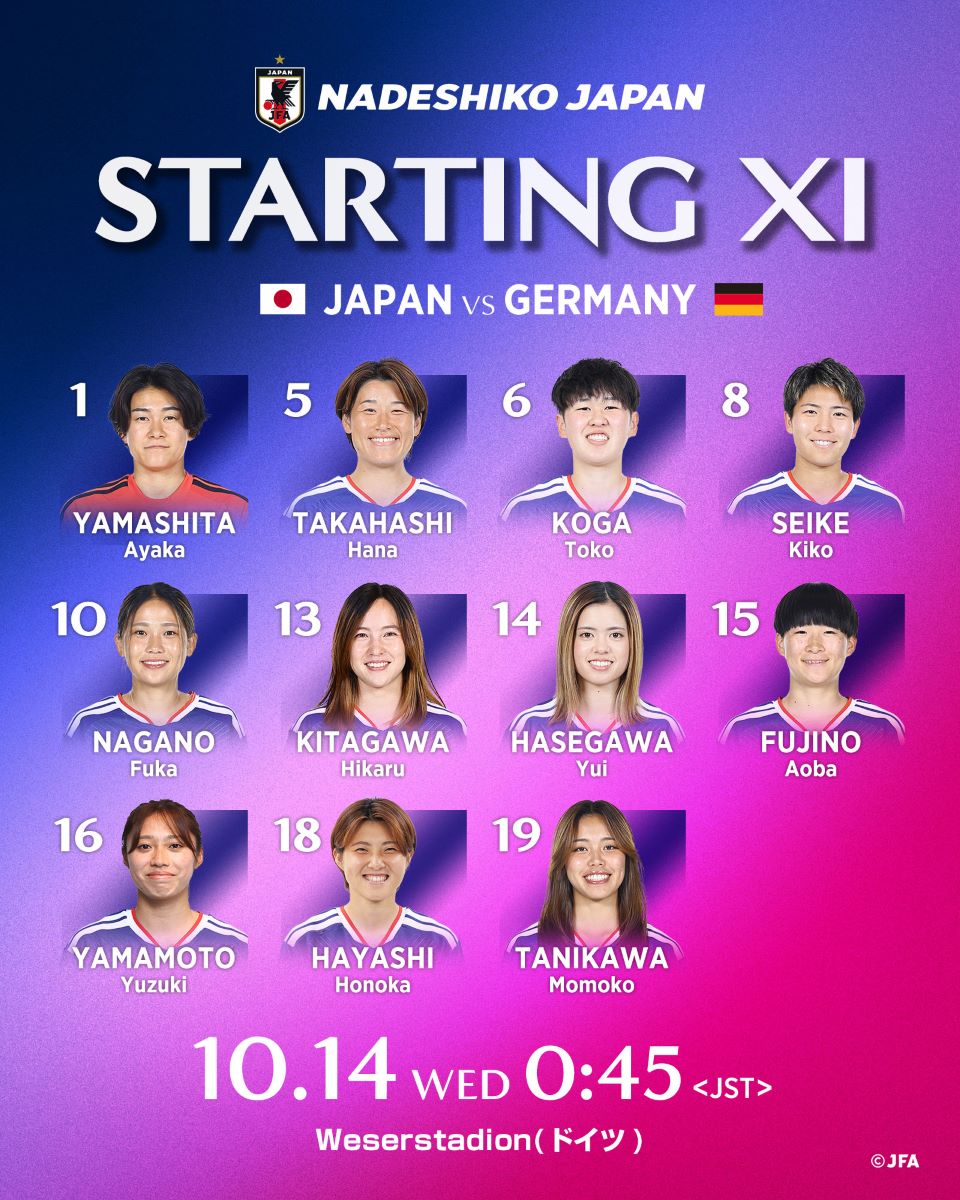
[[The International Friendly Match of October 2026: vs Germany]]
October 13, 2026
Kickoff 4:45 PM
Weserstadion/ Bremen, Germany
[The opponent: Germany]
Germany is a powerhouse among powerhouses, boasting two World Cup titles, one Olympic gold medal, and eight UEFA Women’s Championship victories. After overcoming a slump, the team has recently finished third in the 2023–24 Nations League and the 2024 Paris Olympics, reached the semi-finals of the 2025 European Championship, and finished as runners-up in the Nations League. In terms of both track record and actual ability, they rank above Nadeshiko Japan as currently ranked third in the FIFA world rankings.
Nadeshiko’s all-time record against Germany stands at 1 win, 2 draws, and 11 losses, though they played to a 2–2 draw in their most recent match, an international friendly in 2019.
The current German team is structured around the Bayern contingent, bolstered by key players from other top European clubs.
The player to watch, in the blogger’s view, is left-winger Klara Bühl; the Nadeshiko defense’s ability to handle her—and specifically the choice of which right-back to pit against her—will be crucial.
It will also be interesting to see whether Nadeshiko’s high press proves effective against Germany, depending on the personnel selected for the attack. Will they field forwards who excel defensively, or players with potent finishing ability inside the box? It remains to be seen what strategy Manager Kano has in mind regarding these matters.
In any case, this match is positioned as an ideal international friendly for gauging the current standing of the Nadeshiko. However, it is also true that this depends on the attitude with which the team approach the game: will they approach the game with the mentality of a powerhouse, or will they prioritize defense above all else?
[Result of the match]
Germany 2-1 Nadeshiko
Germany’s goals: L. Dallmann (28′), K. Bühl (73′)
Nadeshiko’s goal: T. Tanikawa (14′)
Overall possession: 56.4:43.6
Shots: 13:9
Total touches inside the opposition box: 30:14
[Match review]
The match between the teams ranked 3rd and 5th by FIFA was highly compelling. Ultimately, Germany secured a come-from-behind victory, thanks to a superior level of tactical organization. While it brings to mind the men’s World Cup match against Brazil this June, the blogger felt that the Nadeshiko players, at the very least, took on a formidable opponent with great courage.
The opening goal for the Nadeshiko was a brilliant piece of play: Yui Hasegawa moved the ball in the right flank to Aoba Fujino, who then delivered an exquisite pass to Momoko Tanigawa in the center; Tanikawa—a true master inside the box—evaded two opposing center backs before burying her shot into the left side of the goal.
Both of Germany’s goals came from shots fired from the left side of the box. As the blogger had anticipated, Klara Bühl played a key role, but the technical ability and work rate of Linda Dallmann were also particularly impressive. It was unfortunate that, on the first goal, Honoka Hayashi—who was moving to catch Dallmann from behind—was obstructed by the referee, preventing her from getting into position in time; furthermore, the ball deflected off the foot of Hana Takahashi, who had slid in to intervene, changing its trajectory and sending it beyond the reach of goalkeeper Ayaka Yamashita. The second goal stemmed from a lapse in judgment: a pass from Yamashita toward Yui Hasegawa was made without sufficient caution, allowing Germany to capitalize. However, it is important to note that the Nadeshiko’s defensive structure had already broken down by that point, and the defensive players were suffering from fatigue—factors that made it difficult for Yamashita to find a viable passing lane.
While manager Kano’s substitutions in the last match against Haiti were brilliant, his choices in this game raise huge serious questions. He kept players on the pitch or brought them on early, who displayed poor ball control just as the Nadeshiko were trying to push back. Furthermore, he opted to keep Maika Hamano, who had the potential to change the course of the match, on the bench; in short, his reading of the game was consistently off the mark.
However, if his primary objective was not necessarily to win this match, but rather to provide the players with experience, one might infer the reasoning behind the—frankly disastrous—decision to deploy the inexperienced Yuzuki Yamamoto as a right-back to mark Germany’s star player, Bühl. As the blogger have pointed out many times previously, he strongly believes that the national team should select players who are natural full-backs—even if they are young—to ensure they gain the necessary experience during international friendlies.
It might already be too late, but why not have coaches like Uchida or Kinga—both of whom were outstanding right full-backs—scout for a promising young side full-back who will truly stand out?
Furthermore, there is a clear need to rethink the Nadeshiko’s tactics against the Nadeshiko counter of their opponent—specifically the tactics employed during the 2023 World Cup and the 2024 Paris Olympics to neutralize their build-up play along the flanks. While some passes into the spaces between the defensive and midfield lines were attempted in this match, the lack of coordination meant that Germany was able to dominate the midfield.
[Blogger’s Comments on Nadeshiko Players]
Yui Hasegawa was losing possession of the ball far more frequently than usual. Had Germany devised a specific plan to counter her? Was it done by Sjoeke Nüsken? And was there a failure for the Nadeshiko to come up with a counter-strategy of their own?
While Yuzuki Yamamoto’s individual efforts deserve recognition, it is clear that she struggled significantly; not only did she frequently look uncomfortable defending from the right full-back position, but she also acted as a bottleneck during build-up play on the right flank. Given her specific profile and temperament, this tactical decision can only be described as inappropriate. This misguided strategy must be abandoned before a player who has honed her skills as an attacking winger on the right flank suffers a setback. If Manager Kano fails to grasp the folly of this approach, one is forced to conclude that there are serious gaps in his imagination and his ability to properly evaluate his players. Or perhaps the situation is such that Manager Kano is unable to defy instructions from someone who seems to have crawled out of the prehistoric era?
If the Nadeshiko intend to employ this style of play against a powerhouse like Germany, which the blogger strongly recommends, they should avoid starting players who lack fundamental technical skills—such as controlling and passing the ball—or who do not grasp the principles of organized defense or the ability to maintain a clear, overarching perspective of their own positioning on the pitch. If such players are to be utilized, they should be brought on as “impact substitutes” in the latter stages of the second half. The blogger wants to make it clear that his suggestion is not concerned with Yuzuki Yamamoto at all.


コメントを残す