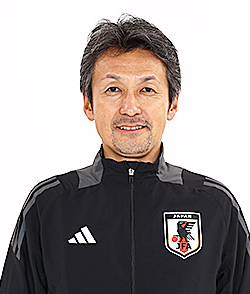
It’s highly likely that the JFA’s efforts to find other candidates were futile, leading to the position falling to Mr. Michihisa Kano, who is “not the best, but not bad.”
From my perspective, Mr. Kano is probably the best among the Japanese candidates. His track record in player development, in particular, is unparalleled.
However, whether he is capable enough of making the Nadeshiko team world champions again remains questionable.
Nevertheless, it’s worthwhile to consider how he compares to his predecessors and those before them, so let’s review Mr. Kano’s career and achievements.
He was born on July 6, 1976, making him 49 years old. It is an ideal age.
He’s from Osaka, and his highest level of education is listed as Osaka Prefectural Hirakata Tsuda High School. His youth career likely involved six years of middle and high school with Hirakata Football Club United. It’s also plausible that he was affiliated with Hirakata FC during elementary school.
For me, his background at a local club especially in Hirakata seems a significant advantage.
Mr. Kano likely attended a university (Osaka University of Health and Sport Sciences?), but at the age of 20, he went to Brazil and spent two years with SE Palmeiras, a prestigious club in São Paulo state. He then spent a year with OSASCO FC, also in São Paulo state, before returning to Japan and joining Sagawa Express Osaka Soccer Club. It seems he chose to gain experience playing for a professional team in Brazil instead of spending four years at a university.
While his experience in Brazil, probably giving him a secure eyes to find talents, is a significant plus point for me, I’ll reserve judgment on his ability to to organize a team to play collectively.
After playing for Sagawa Express for four years, Mr. Kano immediately became a coach (in 2003) and served for four years, holding positions for SAGAWA SHIGA such as a coach , a youth development director, and a U15 manager.
He appears to have maintained his working positions even after the very end of the Sagawa Express team’s disbandment, which is a proof of his reliable personality.
Mr. Kano has been working in the JFA’s women’s football division since 2015. This gives him 11 years of experience coaching women’s football, two years longer than his Japanese predecessor, Mr. Futoshi Ikeda.
Since 2021, he has served as the managers of the Nadeshiko Under-age teams and another, achieving the following accomplishments:
(1) 2022 FIFA U-17 Women’s World Cup: Quarterfinals
Although they won all three group stage matches, they suffered a 1-2 defeat to eventual champions Spain in the first round of the knockout stage. Such players having high potential as Toko Koga, Momoko Tanikawa, and Miharu Shinjo were selected. The defeat was apparently due to their defensive weaknesses that Spain focused on. It should be notices that DPR Korea did not participate. The only goals conceded in the tournament were against Spain.
(2) 2023 Asian Games: Champions
Due to the close schedule with the Paris Olympics Asian 2nd round qualifiers, a team primarily composed of WE League players was formed for the Asian Games, leading to a 4-1 victory over DPR Korea in the final and the championship. While it cannot be fully evaluated due to the unknown selection of opposing players, “winning” a major tournament was included as one of his achievement. In addition, he knows how to activate such a player as Yoshino Nakashima in the Nadeshiko. Japan won the title for the second consecutive Asian Games. Pervious title was achieved under manager Asako Takakura.
(3) U-20 Women’s World Cup 2024 – Runner-up
They advanced through the group stage with three wins out of three matches, and in the quarterfinals, they defeated Spain 1-0 to avenge their loss from two years prior and reach the final. They lost 0-1 to DPR Korea, finishing as runners-up. Players such as Shinomi Koyama, Manaka Matsukubo, Maya Hijikata, Aemu Oyama, Uno Shiragaki, and Akane Okuma were selected. Although they succumbed to DPR Korea, who had superior team tactics, the use of talented young players is commendable. They conceded only two goals throughout the tournament.
Based on the above, the author’s assessment of Mr. Kano as a Nadeshiko Manager is as follows:
His track record in developing female players and his ability to identify the talent of young players are considerably superior.
He has demonstrated skillful techniques to reduce goals conceded in matches up to the group stage and quarterfinals of world tournaments.
However, his coaching ability to achieve equal or superior results against world-class opponents remains unknown.
Indeed, he served as an acting manager in the three-match series against the USA in April, resulting in one win and two losses. In particular, the crucial third match saw three goals conceded in the first 15 minutes of the second half, resulting in a crushing defeat. Even considering potential conditioning issues of the Nadeshiko players, the impression on the third match is that he was “completely helpless” as a manager although using Yuzuki Yamamoto as a forward was a good decision.
Similar disappointing results are unacceptable once after he will have a grasp of the team.
[[ Addendum ]]
At the JFA press conference on May 18, 2026, the staff supporting Mr. Kano (born July 6, 1976) were announced as follows:
Coach: Yukari Kinga (born May 2, 1984)
Coach: Atsuto Uchida (born March 27, 1988)
Goalkeeper Coach: Tomoyuki Sano (born December 14, 1977)
Physical Coach: Ryugo Okamoto (born December 5, 1973) – Retained
Yukari Kinga, who enjoys the deep trust of her juniors in Hiroshima; Atsuto Uchida, who served as a coach for Nadeshiko Japan once in October 2024; and Tomoyuki Sano, who has connections with Mr. Kano through SAGAWA SHIGA FC, all seem to be good choices.
Ms. Kinga, a member of the World Cup-winning team 2011, has diverse experience in England, Australia, China, the Nadeshiko League, and the WE League, which will make her positive at her current position.
Mr. Uchida, who played in Germany, is a promising coaching figure among his contemporaries, and has experience in the (men’s) World Cup.
Both Kinka and Uchida were midfielders in high school, but they both have experience successfully switching to the right side-back position.
Tomoyuki Sano has a track record of developing excellent goalkeepers at Gamba Osaka.
コメントを残す